Radiatively-Cooled Mass Transfer: Disk Properties and L2 Outflows Across Mass Transfer Rates
A movie of the equatorial plane of four of the MT simulations I performed, for decreasing MT rate (10-1 M⊙/yr, 10-2 M⊙/yr, 10-3 M⊙/yr, 10-5 M⊙/yr). Mass is initialized in an envelope atop the donor's core. As time progresses, mass flows toward the companion M2, located a distance a from the donor. Also labeled are two Lagrange points, L2 and L3. Time is in units such that 2π corresponds to one orbit.
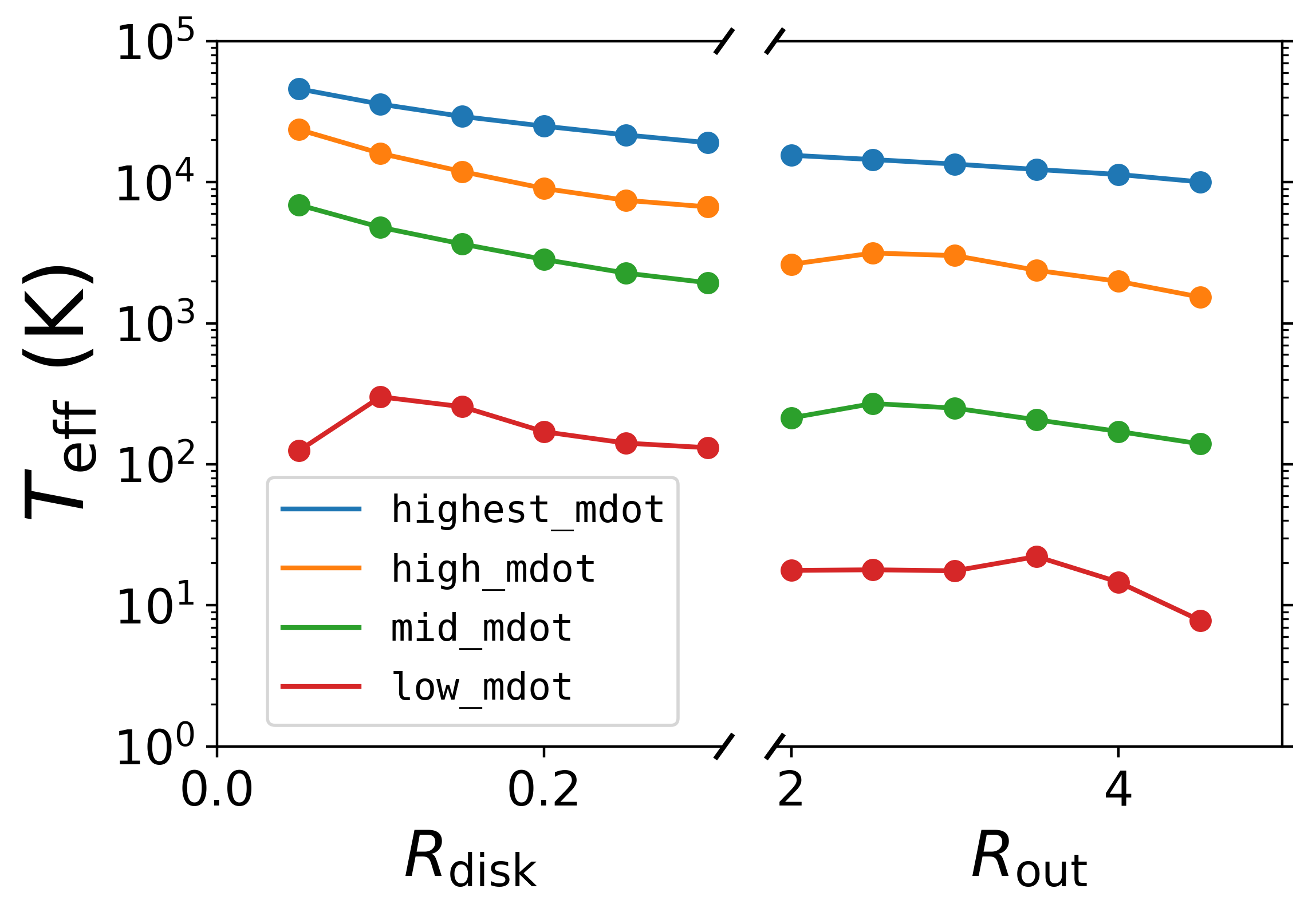
I performed hydrodynamic simulations of binary mass transfer (MT) incorporating radiative cooling of the gas. This probes a broader range of MT rates than the previous simulations (here), which assumed the gas was adiabatic and were most valid at very high MT rates (>10-2 M⊙/yr). In the simulations, mass flows from the donor into an accretion disk, with significant equatorially-concentrated outflows through the outer Lagrange point L2 occurring for MT rates ≳10-3 M⊙/yr, while the MT remains mostly conservative for lower MT rates. In all cases, any outflowing gas approximately carries the specific angular momentum of L2. The gas cooling luminosity L and temperature increase with MT rate, with L ∼ 105 L⊙ and T ∼ 104 K for simulations featuring the strongest outflows, with contributions from both the accretion disk and circumbinary outflow. Although the most luminous transients associated with mass outflows will be rare due to the high MT rate requirement, they will generate significant optical emission from both the accretor's disk and the circumbinary outflow.
Because each simulation required hundreds of thousands of core-hours on high-performance computing clusters, only a small grid spanning the primary parameter, mass transfer rate, was feasible. Future work can explore additional dimensions of parameter space, such as donor structure and mass ratio.
The average gas effective temperature Teff in the accretion disk near M2 and in the circumbinary disk, for simulations of varying MT rate. The curves shown are calculated over cylinders of constant cylindrical radius Rdisk about M2 and constant Rout about the origin