Ultra–short-period WD Binaries Are Not Undergoing Strong Tidal Heating
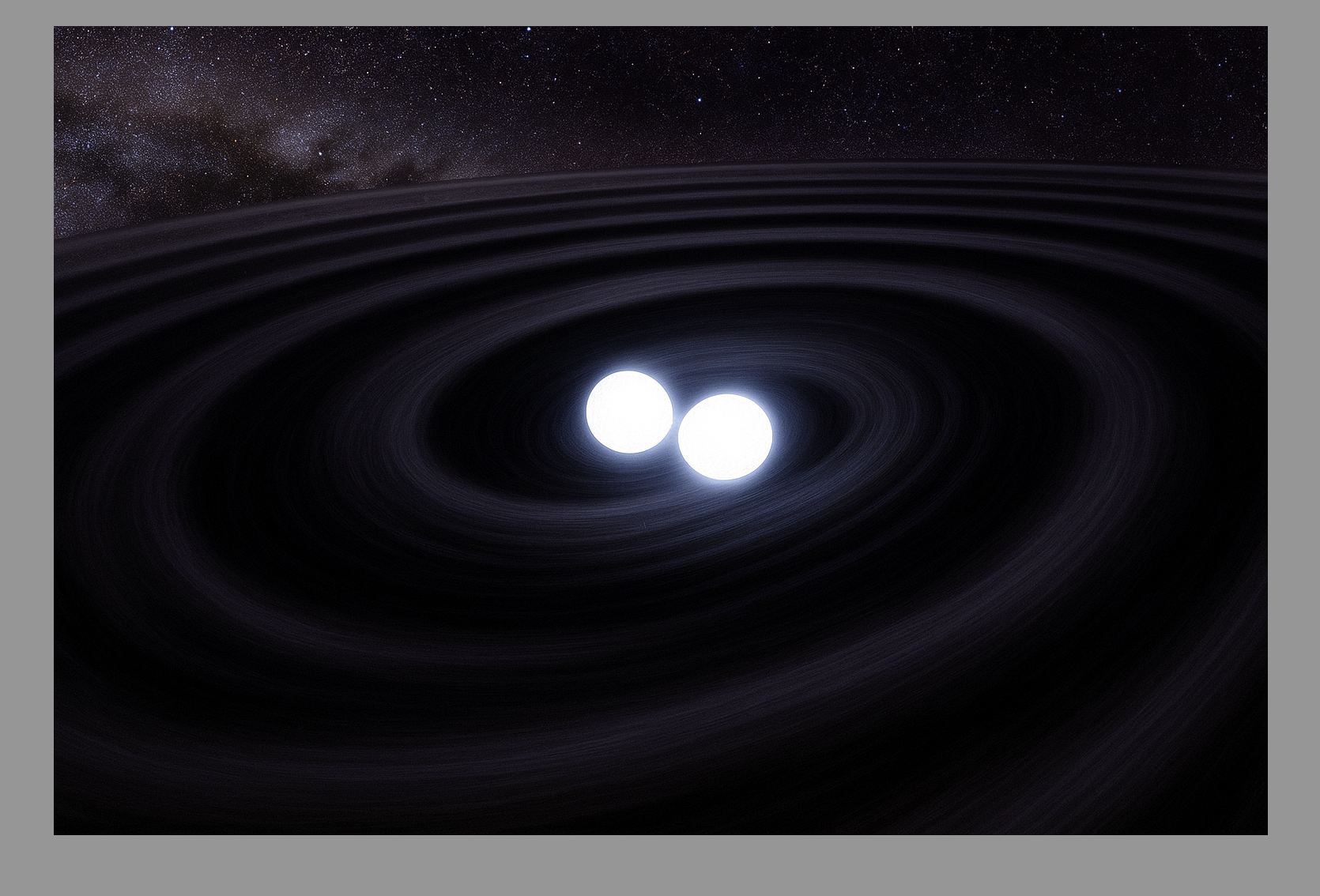
A cartoon of two white dwarves in a close binary, undergoing inspiral due to the emission of gravitational waves.
I extended my previous work modeling double WD binaries (here) by adding double WD binaries at very short orbital periods (< 20 minutes) to my sample and incorporating strong tidal effects. Assuming the tidal response inside the WD primary, driven by its companion's potential, is a gravity wave carrying energy and AM, I implemented a tidal heating and spin-up model in MESA. It self-consistently calculated wave amplitudes and energy deposition, increasing the WD's rotation and heating near-surface layers. Comparing model Teff values to observed binaries, I found that tidal heating modestly increases Teff for systems with periods < 10 min but is not the dominant source of luminosity - instead, these ultrashort-period WDs are intrinsically young and hot, suggesting formation at short orbital periods and also being consistent with a relatively low CE efficiency.
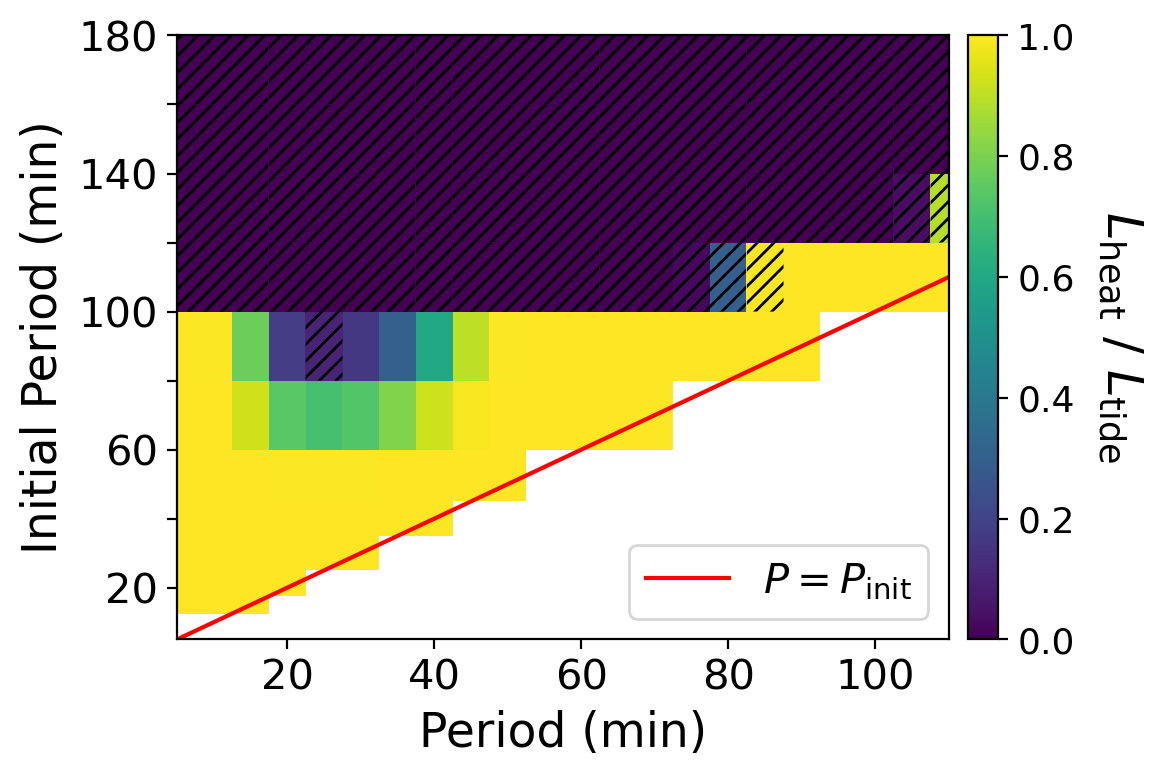
The fraction of the wave energy Ltide that is deposited as heat Lheat (color shading) within evolving WD models of 0.25 M⊙ (with a 0.3 M⊙ companion). A given simulation starts on the red line and moves from right to left horizontally, toward shorter orbital periods as inspiral occurs. If Lheat/Ltide is less than unity, the wave is encountering the upper edge of the propagation cavity, where the wave frequency rises above either the Lamb frequency (unhatched region) or the Brunt–Väisälä frequency (hatched region). The traveling-wave approximation that is used in this paper is good in the yellow regions of this diagram.
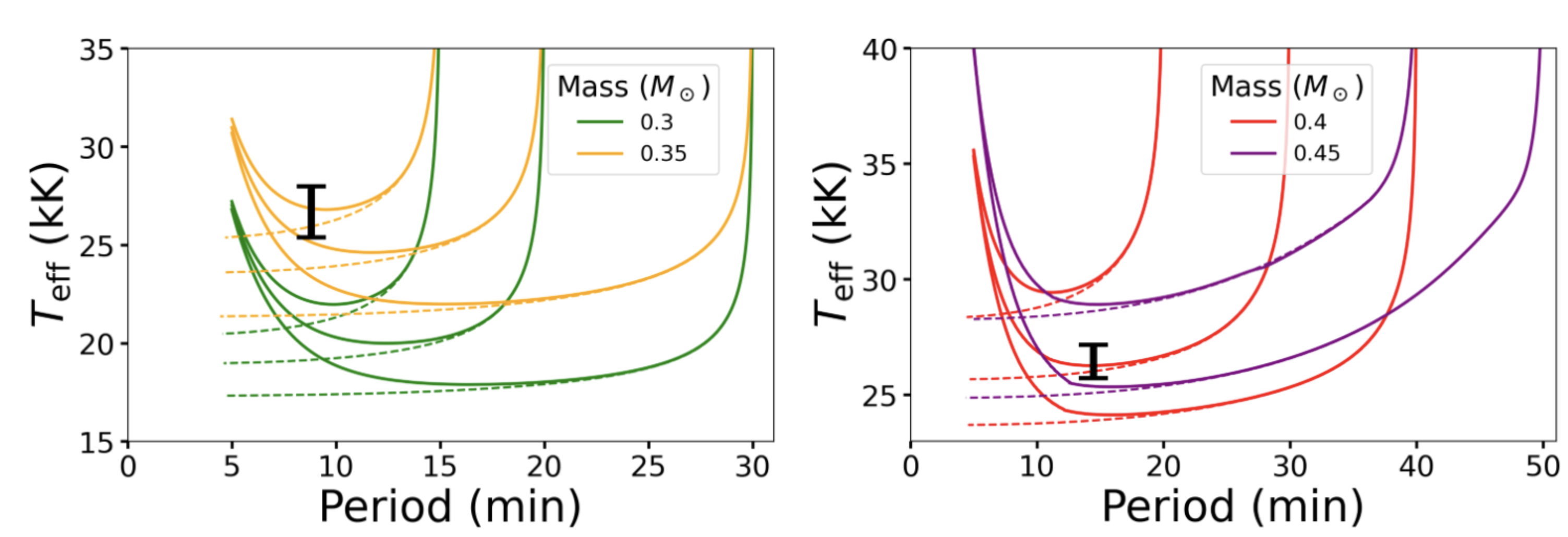
Effective temperature vs. orbital period for a grid of WD simulations, compared to the observed temperature (black error bars) of two WD binary primaries. The models vary in WD mass (differing colors) and initial orbital period of the system, whereas companion mass is fixed at 0.3 M⊙. Dashed lines are models with the same parameters, but with tidal heating turned off. At the observed period, the difference between models with and without tidal heating is modest. Therefore, the hot observed temperatures imply a short initial orbital period, i.e. that the WD is intrinsically young and hot.